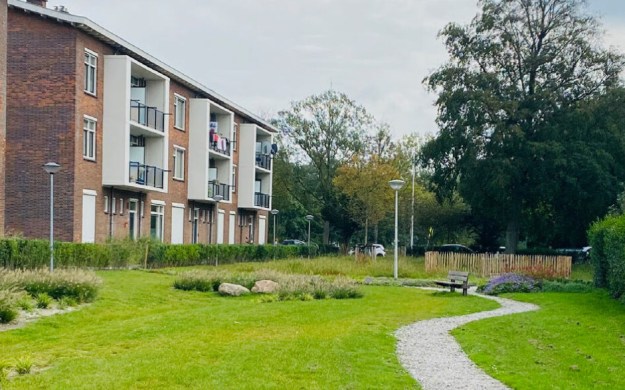
The Hague Southwest is a district in the city of The Hague, consisting of four early postwar neighbourhoods: Bouwlust, Vrederust, Morgenstond and Moerwijk. These four neighbourhoods provide accommodation to approximately 70,000 residents, which is comparable to the size of a small Dutch city. Many residents in these areas suffer from poverty, long-term unemployment, physical and mental health issues. For youngsters, there is a lack of opportunities related education, work, and leisure. Almost half of the residents struggle to get by on a daily basis and many residents often feel not safe in their own neighbourhood. The majority of the housing consists of medium-rise apartments in the social rented sector, many of which are nearing the end of their life cycle. The Hague Southwest has a lot of public space, but not all of this is used in optimal ways. Moreover, the region-wide need for significant housing construction has sparked a debate about densification in the area. The city of The Hague, local housing associations and the national government have joined forced in the so-called ‘Regiodeal Den Haag Zuidwest’ and will invest a lot of resources into these neighbourhoods in the coming years.
In this context, the LDE Centre Governance of Migration and Diversity (of which our faculty is one of the lead partners) has initiated a so-called Master Thesis Workshop The Hague Southwest. This graduation lab initiative aims to make a positive contribution (through graduation research and education) to the ambitions for The Hague Southwest. Within the Master Thesis Workshop (MTW), students with different backgrounds from the universities of Delft, Rotterdam and Leiden work on special themes/challenges.
Each student will be supervised by his/her own supervisors at the ‘home’ faculty. However, the MTW will offer an interdisciplinary vehicle for regular exchanges, not only between students, but also between students and civil servants from the city, housing associations and other professional actors. In other words, if you are keen on working together in your graduation project with other disciplines and with societal stakeholders, this may be a good choice for you. Your ‘home base’ will be the Planning Complex Cities Studio, but you will also be periodically active in the LDE Master Thesis Workshop.
The City of The Hague has offered a list of challenges (in Dutch) that they would like to be addressed by graduate students from the constituent faculties and departments represented in the LDE Centre Governance of Migration & Diversity. Below are some ‘typical’ Urbanism / Planning Complex Cities themes, which students can take on from September 2023 onwards:
- The design of inner courtyard gardens in relation to realising ownership by residents or citizens for green space. The housing association Haag Wonen actually have inner courtyard gardens that they can put forward as case studies.
- (Perceived) safety and local economy in relation to public space. The Safety Department of the municipality of The Hague is particularly interested in how to design the plinths of buildings and public spaces in such ways to increase citizens’ perception of safety. Of particular interest is the question to what extent shops in the plinths actually contribute or detract from the perception of safety.
- Placemaking: what can temporary initiatives in public space and beyond mean for The Hague Southwest? What are success factors of this type of temporality? What about examples and experiences elsewhere (whether or not based on empirical research)? How do placemaking and related temporal initiatives contribute to area redevelopment in general, and strengthening social cohesion/community in particular? Under which conditions do placemaking and related temporal initiatives contribute to (perceived) ownership by residents and local entrepreneurs?
For more information, please contact: R.J.Kleinhans@tudelft.nl
 Planning Complex Cities TU Delft