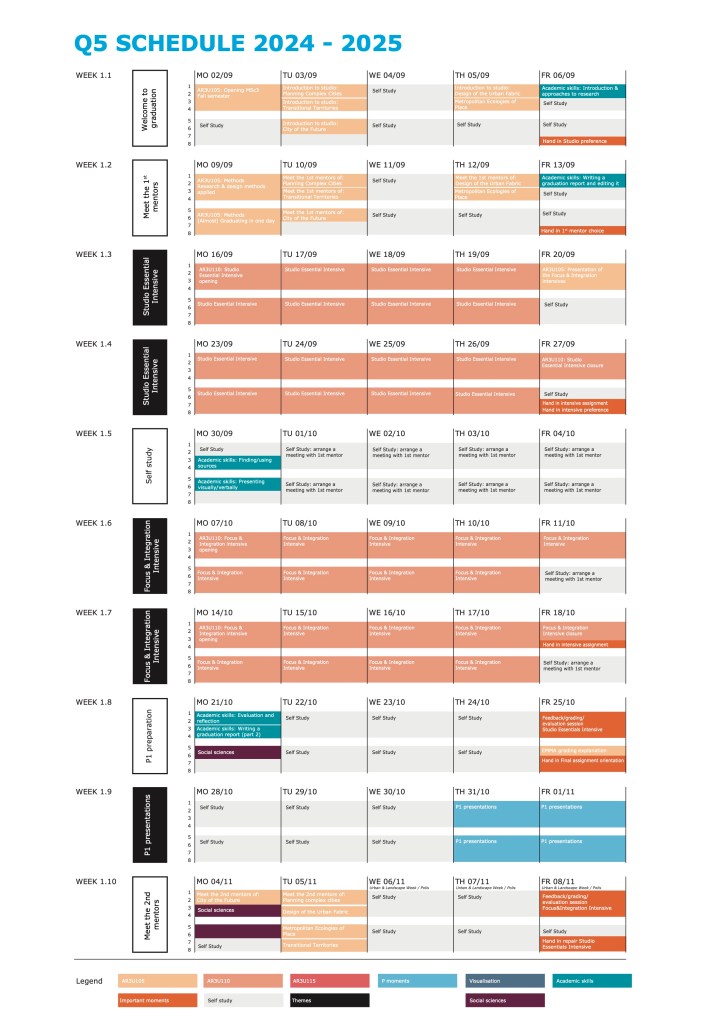
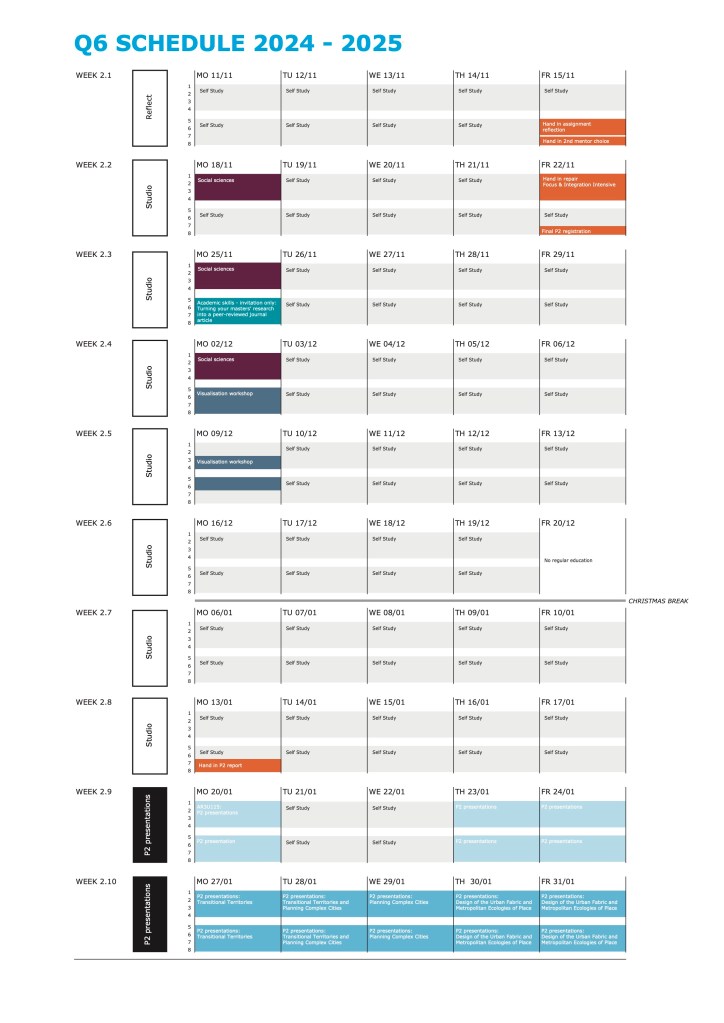
For an overview of the graduation schedule for Q5-Q6 2024-2025 see the tables above. Below you will find more information on the Planning Complex Cities activities in this period. Please keep an eye on this webpage throughout graduation because information on events will be regularly updated.
Planning Complex Cities graduation orientation
The first two weeks of MSc Urbanism graduations are dedicated to orientation. During this period students select a studio and indicate a preference for a 1st mentor. The Planning Complex Cities group assists in this during two events.
- Planning Complex Cities: An introduction to the studio.
3 September 2024, 8:45 – 10:45, Berlage 1
By studio coordinator, theme leaders and project researchers.A first event will elaborate the themes of Planning Complex Cities graduations and provide insight into the basic workings of the studio. - Planning Complex Cities: A workshop to find common interests.
By Planning Complex Cities mentors
12 September 2023, 8:45-10:45, Hall B
A second event is intended to help students to reflect upon the implications of Planning Complex Cities topics for their graduation project proposals. In addition it provides students with the opportunity to meet available Planning Complex Cities mentors in person and discuss the early project ideas with them.
Planning Complex Cities graduation exploration
Weeks 3-8 of the MSc Urbanism graduation curriculum are dedicated to the exploration of key graduation topics and methods. Two two-weekly classes – so-called intensives – supports students in this exploration and thus the building of a thesis plan. Intensives that are closely aligned with the scope of the Planning Complex Cities studio are called On Planning Theory & Practice, and Governance, Policies and Stakeholders.
On Planning Theory & Practice – Exploring relations between spatial and institutional change
The basic starting points of Planning Complex Cities graduation projects are observations of disparities and conflicts arising from the distribution of spatial resources across communities and territories. In a typical graduation trajectory, central propositions on the institutional causes and drivers of these spatial manifestations of inequity are first formulated. Those propositions may concern formal institutions embodied in, for example, legal and regulatory planning frameworks, policy delivery mechanisms, obligatory cooperation between governments, or formal distributions of power. Propositions may also concern informal institutions, e.g. the voluntary engagement of communities in planning processes, invisible power distributions, planning and governance cultures, traditionalised norms guiding spatial practices, dominant discourses, or even ideologies. During Planning Complex Cities graduations, the interrelations between spatial and institutional factors are explored in depth. Conclusions from projects typically target institutional change and demonstrate how this change can lead to new, more sustainable and just spatial development, by means of design.
The intensive ‘On Planning Theory & Practice’ aims at supporting students in the laying of conceptual foundations for Planning Complex Cities graduations. Students sketch problem definitions, propositions, research aims, questions, and outcomes concerning the above described interrelations. Lectures will introduce them to theories from the fields of design, planning, the political sciences, and geography, thus allowing for the positioning of initial project proposals in these fields. Discussions on spatial planning and design practice will support this positioning. Workshops and self-study exercises will enhance the application of knowledge to the cases students intend to investigate, and thus the building of a thesis plan. The intensive course will also touch on methods used to assess the performances of spatial planning and enable initial thoughts on an appropriate research methodology in this way.
Programme
The program of the class is designed to support an iterative approach to the building of a thesis plan. Students will firstly sketch a problem field and envision an outline solution, and secondly develop a more detailed problem definition and proposition on how spatial planning can lead to more sustainable and just spatial outcomes. The program of the class foresees four themed blocks:
- #1 Why spatial planning? – This block first discusses the wide array of socio-spatial developments that can trigger a demand for spatial planning. Through reflecting on notions about public goods, spatial justice, and democracy, it then introduces central (at times contested) definitions of and arguments for and against planning. Centrally the block elaborates the subjects of spatial planning: territory, space, and place. It is shown how different perceptions of these subjects have influenced the evolution of planning fashions over time. Students will use input for the initial positioning of their research in scientific debate, and the outlining of a problem field.
- #2 Performances of spatial planning – By distinguishing planning principles, scopes, processes, and performances this block first provides a simple glossary for navigating spatial planning literature. The block’s main concern is an understanding of the context of critical spatial planning endeavours: institutions. A distinction of kinds of institutions will help students to detail the context they address by their research and design. They will use input for conceptualising a ‘solution space’: the kind of change they aim to investigate during their graduation.
- #3 Ingredients of spatial planning: This block first elaborates determinants of spatial planning systems: the ways institutions help or hinder intended spatial planning outcome. It then discusses planning approaches that have emerged as a response to challenges and crisis recently. A distinction of these approaches and related instruments is intended to help students determine the problem field and aim of their graduation projects in more detail. Students will use input for drafting research questions too.
- #4 Design & spatial planning: This block discusses the roles and performances of spatial design in the realms of spatial planning, governance, and civic participation. The block first introduces design and planning theory that explains these performances. It then discusses the impacts of kinds of designs on kinds of planning processes. The block will help students to formulate intended design outcomes of their graduation projects, and to anticipate on their critical engagement using these results.
After completion the student is able to
- demonstrate an understanding of the aims and impacts of spatial planning practice;
- distinguish spatial planning approaches conceptually and theoretically, and identify the relevance of approaches for distinct spatial and institutional circumstances;
- distinguish design approaches by their performances in the realms of planning, governance, and civic participation;
- use acquired knowledge for the building of a thesis plan.

Governance, Policies and Stakeholders (Focus & Integration Intensive)
While not part of the PCC studio and open to all MSc Urbanism students, this intensive workshop is closely related to the studio’s themes and methods. It provides the students with a conceptual foundation for a critical understanding and methodological one for researching governance and stakeholder engagement in spatial planning for regions and cities. Building on theoretical insight and hands-on assignments, the workshop will equip the students with skills and tools to explore and assess the performance of planning in terms of identification, articulation and coordination of stakeholder interests and inclusive decision-making in an increasingly complex and uncertain world.
The course takes place in weeks 6 and 7 of MSc3 (7-18 October 2024).
More information will be provided at the presentation of the intensives on 20 September 08:45-12:45 in Hall B.
The course is coordinated by Marcin Dąbrowski and Juliana Gonçalves.
P1 and post-P1 Planning Complex Cities studio programme
The first assessment moment of Planning Complex Cities graduations – called P1 – will happen on 31 October – 1 November 2024. After this assessment a series of workshops will support students’ further development towards P2, the second and more formal go/no go assessment of MSc Urbanism graduations. The workshops will most often take place on Tuesday mornings. The programme will involve a range of speakers and facilitators (mentors, alumni, experts, PhD Candidates, practitioners). Here is an overview of the sessions and topics:
| Date and time | Topic | Facilitators |
| Tue 12 November, 08:45 – 10:45 | #1 Developing theoretical and conceptual frameworks | Marcin Dąbrowski and Gregory Bracken |
| Thu 14 November 08:45 – 10:45 | #2 Sub-themes sessions | Theme leaders + Alumni |
| Tue 19 November, 13:45 – 16:45 | #3 Building a methodology | Marcin Dąbrowski and Lei Qu |
| Thu 21 November, 08:45 – 10:45 | #4 Spatial justice | Roberto Rocco |
| Tue 26 November, 08:45 – 10:45 | #5 Data management and ethics | Janine Strandberg (Data Steward) and Marcin Dąbrowski |
| Tue 3 December, 08:45 – 10:45 | #6 Finetuning research methods | Marcin Dąbrowski and Thomas Verbeek |
| Tue 10 December, 08:45 – 10:45 | #7 Copyright and how to deal with it | Marcin Dąbrowski and Gregory Bracken |
| Tue 17 December, 08:45 – 10:45 | #8 Preparing fieldwork | Zef Hemel and Marcin Dąbrowski |
| Tue 7 January, 08:45-10:45 | #9 Defining scientific and societal relevance | Remon Rooij and Marcin Dąbrowski |
| Tue 14 January, 08:45-10:45 | #10 Storytelling in planning | Zef Hemel + guests TBC |
| Tue 21 January, 08:45-13:45 | #11 Mock P2 presentations | Peers + Alumi |
Other studio activities
Discussing Planning Complex Cities graduations
The first weeks of MSc Urbanism graduations are dedicated to orientation and exploration. After this period Planning Complex Cities students and mentors will form dedicated groups to discuss the progress of graduation projects. Initial discussions will relate to the Planning Complex Cities sub-themes Complex Regions in Transformation and Planning as Critical Engaged Practice. At later stages students will have a strong say in determining issues that require discussion.
Peer review and learning at the evaluation moments (Ps)
The studio programme foresees regular peer-exchange and learning during or around in particular assessment moments of graduations. P1 and P3 will be common events. Other assessment moments of students (P2, P4, P5) will be broadly announced, so students have the opportunity to learn from each other’s presentations. Presence of the studio members at those presentations will be strongly encouraged.
The studio as a social setting
Since the establishment of the Planning Complex Cities studio, we have built routines that support the formation of a socially engaged studio group. Students are engaged in a range of pre-planned and bottom-up activities that enhance peer-exchange and provide opportunities to socialise.
Responsibilities
The Planning Complex Cities studio involves – next to students – alumni students, PhD Candidates, mentors, professionals, and other experts whose research interests, values and practical experience relates to that of the studio. The studio is coordinated by Marcin Dąbrowski (m.m.dabrowski@tudelft.nl).
The coordinator:
- Helps students find the right mentor during graduation orientation;
- Organises studio activities;
- Provides students with relevant information/runs the Planning Complex Cities website (in case students wish to publish information, please don’t hesitate to get in touch – the blog is a great vehicle for publicising your work, events, etc.);
- Is keen to discuss in case students have new ideas or suggestions about the studio format and activities, feel unsatisfied with the studio in any way, or face particular problems during graduation.
 Planning Complex Cities TU Delft
Pingback: Upcoming events. |
Pingback: Upcoming events. |
Pingback: Orient! First event. |
Pingback: Inclusive Cities – Sao Paulo, Shenzhen. |
Pingback: Global cities – Third event on Complex cities graduations. |
Pingback: Internationalisation and Planning – Fourth event on Complex cities graduations. |
Pingback: Next round! | Planning Complex Cities TU Delft